



Fieldnotes is a weekly read for the people inside companies who shape how AI gets used. Learn more about Superadditive.
This week’s main thing
8,000 at Meta. 3,000 at Intuit. 1,100 at Cloudflare. 4,000 at Cisco. 4,000 at Block. More than 113,000 tech workers have lost their jobs at 179 companies this year, almost all of them blamed on AI.
This week’s main thing is the how: how were these cuts decided, was it a smart approach, and if not, what should companies do instead?
Cloudflare is the most public case study: On May 7, CEO Matthew Prince emailed his company announcing that 1,100 people — about 20% of the workforce — would be laid off. The email framed it as restructuring for the agentic AI era. Then, Cloudflare’s stock dropped 24%. Two weeks later, Prince published an op-ed in the WSJ explaining his rationale and naming a category of worker — “measurers,” borrowed from Peter Drucker’s 1954 The Practice of Management — as the kind of work AI is rendering obsolete.
And yes, the rationale came after the cuts (or so it seems).
Across the six biggest AI-linked layoffs of the past four months, the general order of operations has been:
Capex pressure or a correction need comes first. Meta needs to fund $145 billion in 2026 AI infrastructure spending, more than double last year’s. Block is correcting a 2019–2022 hiring spree that tripled headcount. Cloudflare is under analyst pressure on margins. None of these companies really started from “AI is changing what work we need done.” They started from a budget problem.
A target gets delegated down to VPs. A senior Microsoft source told Blind that the layoff decisions were being made “two or three levels below Satya” — by people with a budget target, not by people who can see the work.
Individual employees get identified using whatever proxies are at hand. Meta’s May 14 internal memo instructed managers to put 15–20% of employees in the “below expectations” bucket, up from 12–15% last year. Microsoft cut on tenure-and-compensation proxies. Cloudflare cut against “all teams and geographies except for salespeople who carry revenue quotas.” None of these are theories of what AI is doing to the work, btw. They are sorting mechanisms to hit a predetermined number.
The AI rationale gets attached at the top, for the press and the board. Zuckerberg told Meta employees in an April 30 town hall that AI is not driving the cuts. The same week’s external press release framed them as agentic-era restructuring. Two competing messages for two different audiences, no real effort to streamline them or acknowledge that they conflict.
The organizational framework arrives last. Prince’s “measurers” framework didn’t drive the Cloudflare decision; it appeared two weeks after the layoffs, after the stock had dropped, in an op-ed pitched at other CEOs.
Were these cuts smart? It depends on the goal.
On the merits of AI-as-productivty-god claim, no. Not a single one of these companies seems to have seriously approached the effort with the goal of maximizing productivity.
As short-term financial ploys, yes the cuts have mostly worked: some stocks fell and then recovered, some stocks jumped, and immediate margins have improved. How smart any of these cuts are will take time to find out.
(Klarna is the cautionary tale: they fired 10% of their staff and then had to rehire when customer service tanked.)
It’s clear, though, that we’re just at the beginning of a bigger wave to come. What’s happening in tech is just getting started and is going to hit every other industry eventually.
To us, hand-waving at general management roles as defunct, corrupt, etc. is just lazy. So, we’re left as partners to either sit on the sidelines and boo these moves or at least offer an approach that would be more strategic and more humane (than say, a haphazard or rushed approach). It’s a real trolley problem for us, but that’s what this newsletter is about this week, and that’s what any layoff should try to be: the less bad option.
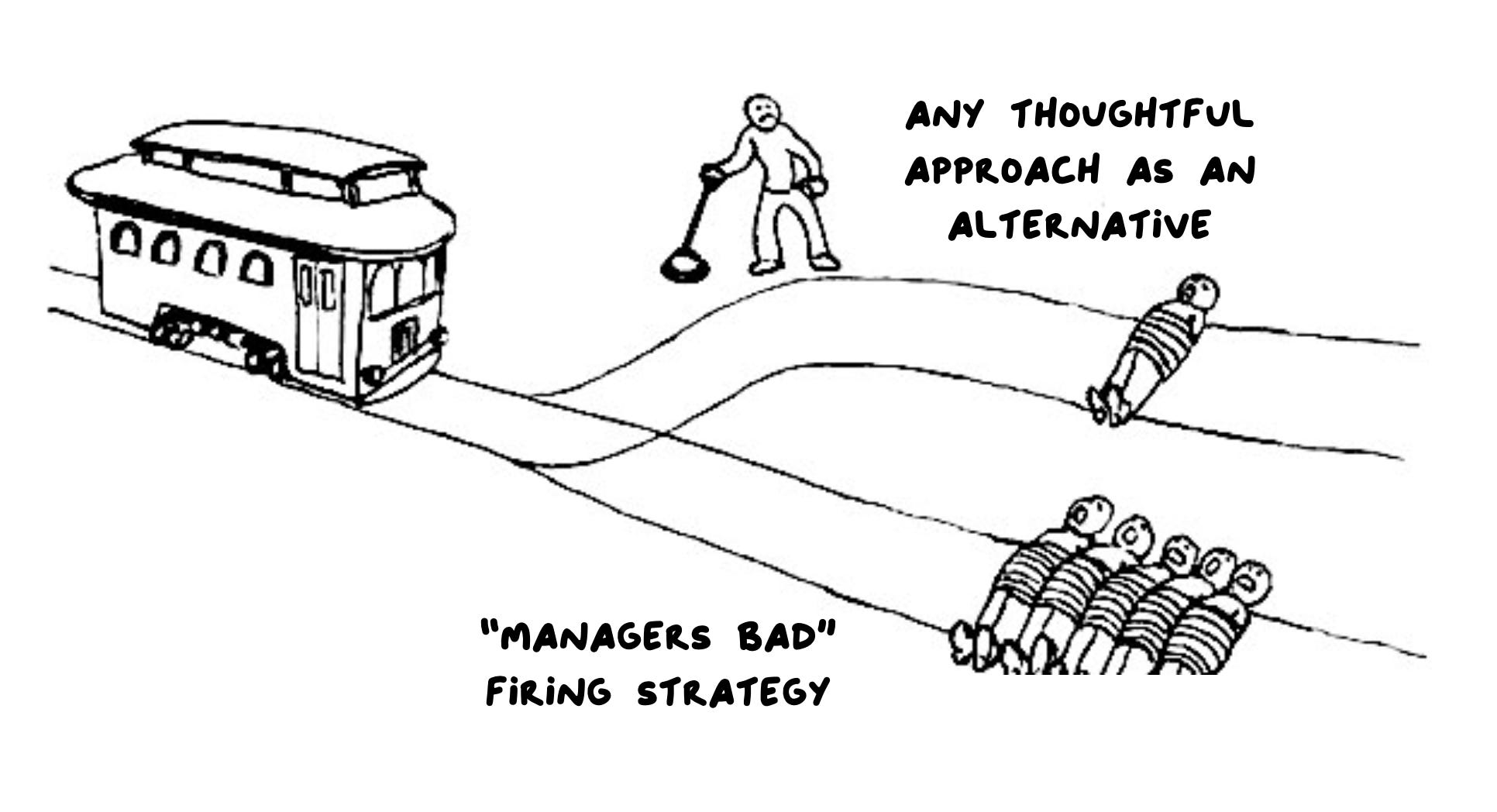
Here’s what to say to your CEO this week: I know we feel cornered to cut. I know that shareholders want to see margin improvement and I know our board wants to see us invest more in AI. I know what that means. That we need to cut. But before we do so, let’s approach the task with more than post hoc rationalizations. Let me have a real try at doing this right, out of respect for the people we’re letting go and for the good of the company we’ll have to run on the other side of the decisions.
This week’s move: How to Conduct AI-Related Layoffs
If you’re a chief of staff at a company that has agreed to invest in AI without cutting margins, costs have to come from somewhere. The question above your pay grade has been answered: yes, costs come out somewhere. What you’re being asked to help with is where and how, while trying to do your best for the people around you and the company’s future.
Most of the layoffs happening in 2026 skip the rigor in favor of vibes and hype. You demand more and so do we.

Top stories
Cloudflare CEO Matthew Prince publishes WSJ op-ed naming “measurers” as the category AI replaces. Two weeks after Cloudflare’s May 7 layoff of 1,100 people, Prince published a Wall Street Journal opinion piece on May 20 retrofitting Peter Drucker’s 1954 “builders, sellers, measurers” framework to argue that middle managers, finance, legal, internal audit, and revenue recognition workers are obsolete. The May 7 employee email contains no mention of Drucker or “measurers.” Between the two documents, Cloudflare stock fell 24%. The op-ed has been widely shared and is already being cited by other CEOs as the framework for the next wave of cuts. Source: Fortune, May 21.
Meta begins notifications on its 8,000-person cut, with the leaked memo showing the “below expectations” bucket widened from 12-15% to 15-20%. Meta started sending layoff notices on May 20. A May 14 internal memo, viewed by Business Insider, instructed managers to put 15 to 20 percent of employees into the lowest performance bucket — up from 12 to 15 percent last year. Selection criteria included below-expectations ratings, formal discipline in the past six months, and open employee-relations cases. Mark Zuckerberg told employees at an April 30 town hall that AI is not driving the cuts. The external press release frames the layoffs as restructuring for the agentic AI era. Both messages went out from the same company in the same week. Sources: Business Insider, May 14; NPR, May 20.
Intuit CEO Sasan Goodarzi tells CNBC the company’s 17% workforce cut “had nothing to do with AI.” On May 20, the same day Meta began notifications, Goodarzi told CNBC that Intuit’s 3,000-person reduction was about simplifying the company’s structure, not AI. “That really led us to three areas that drove the reduction in the workforce,” he said, naming organizational complexity and the goal of a faster-moving “builder culture.” Source: CNBC, May 20.
Google DeepMind UK workers send formal letter requesting union recognition — the first frontier AI lab to organize collectively. Workers at Google DeepMind’s London office voted 98% in favor of joining the Communication Workers Union and Unite the Union in April, and sent a formal recognition letter to UK managing director Debbie Weinstein this week, giving management 10 working days to respond or face legal proceedings. Sources: Fortune, May 5; Gizmodo; Resultsense, May 6.
University of Florida researchers presenting at IEEE Symposium on Security and Privacy this week show commercial AI-text detectors have false negative rates up to 99.6%. In a paper titled “AI Wrote My Paper and All I Got Was This False Negative,” Patrick Traynor, Seth Layton, Bernardo Madeiros, and Kevin Butler tested commercially available AI-text detection tools and found false positive rates between 0.05% and 68.6% and false negative rates between 0.3% and 99.6%. With a simple tweak to the LLM, the detectors were rendered effectively useless. The researchers conclude the tools are “poorly suited for deployment in academic or high-stakes contexts.” Worth holding close for the chief-of-staff reader: if your HR or compliance team has bought, or is about to buy, a tool to police AI use in employee work, the underlying technology is currently incapable of doing the job. Source: EurekAlert, May 2026.
Last time around
April 1981. Jack Welch had just been named CEO of GE. The company employed 404,000 people across hundreds of business lines and a dozen industries, and Welch’s instinct was that GE had grown too comfortable and too padded with managers whose work nobody could measure. He introduced what he later called the “vitality curve.” Every manager in every division would be ranked annually. Top 20 percent A players. Middle 70 percent B players. Bottom 10 percent C players. The C players would be fired. The press called it “rank and yank.” Welch became known as Neutron Jack — he vaporized the people and left the buildings standing.
Between 1981 and 1989, GE shed roughly 170,000 jobs. Revenue grew modestly. Profits more than doubled. Wall Street loved it. Fortune named Welch Manager of the Century in 1999.
Microsoft adopted stack ranking under Steve Ballmer. Inside the company, it became the source of nearly all the morale damage of the 2000s. Amazon adopted a version of it. WeWork was using it as the company was growing toward its valuation peak. GE itself ended the practice years after Welch left, by which time the company had begun a long slow decline that ended with its removal from the Dow Jones Industrial Average in 2018.
Sources: Wikipedia (Vitality curve); Bloomberg Businessweek; NPR Planet Money.
Potpourri
From someone who’s also exhausted. Ferhat Dirik, owner of London restaurant Mangal II, on what the always-on attention economy has done to running a restaurant. “We live in the information, digital age and we move with the times. But it is exhausting. Every time I’m on my Instagram feed, it’s another dozen restaurants desperately trying to fill the space and get covers in with some new information or another. My own restaurant is not immune to this either. If a week passes with no news or updates, bookings slow down. It feels like we’re all contestants on Britain’s Got Talent, performing circus acts walking the tightrope of doom, not looking down to witness the abyss of the industry... We’ve had to become entertainers, where the food and the service and the trust of word-of-mouth is simply not enough. Where does it end?” Source: Mangal II newsletter, May 2026, via Web Curios.
From the weirder edge of the week. Andon Labs — a group running experiments somewhere between art project and AI safety research — gave a set of leading AI models budgets and instructions to run their own internet radio stations. The resulting streams, at Andon Labs Radio, are the kind of thing where you can almost hear each model deciding what counts as music. Minimal modern classical, strange approaches to ads and monetization, occasional cul-de-sacs into something genuinely unhinged. It’s not great radio. It’s a very interesting artifact about what autonomous AI agents do when you give them a budget and tell them to do something open-ended. Source: Andon Labs Radio, via Web Curios, May 22.