


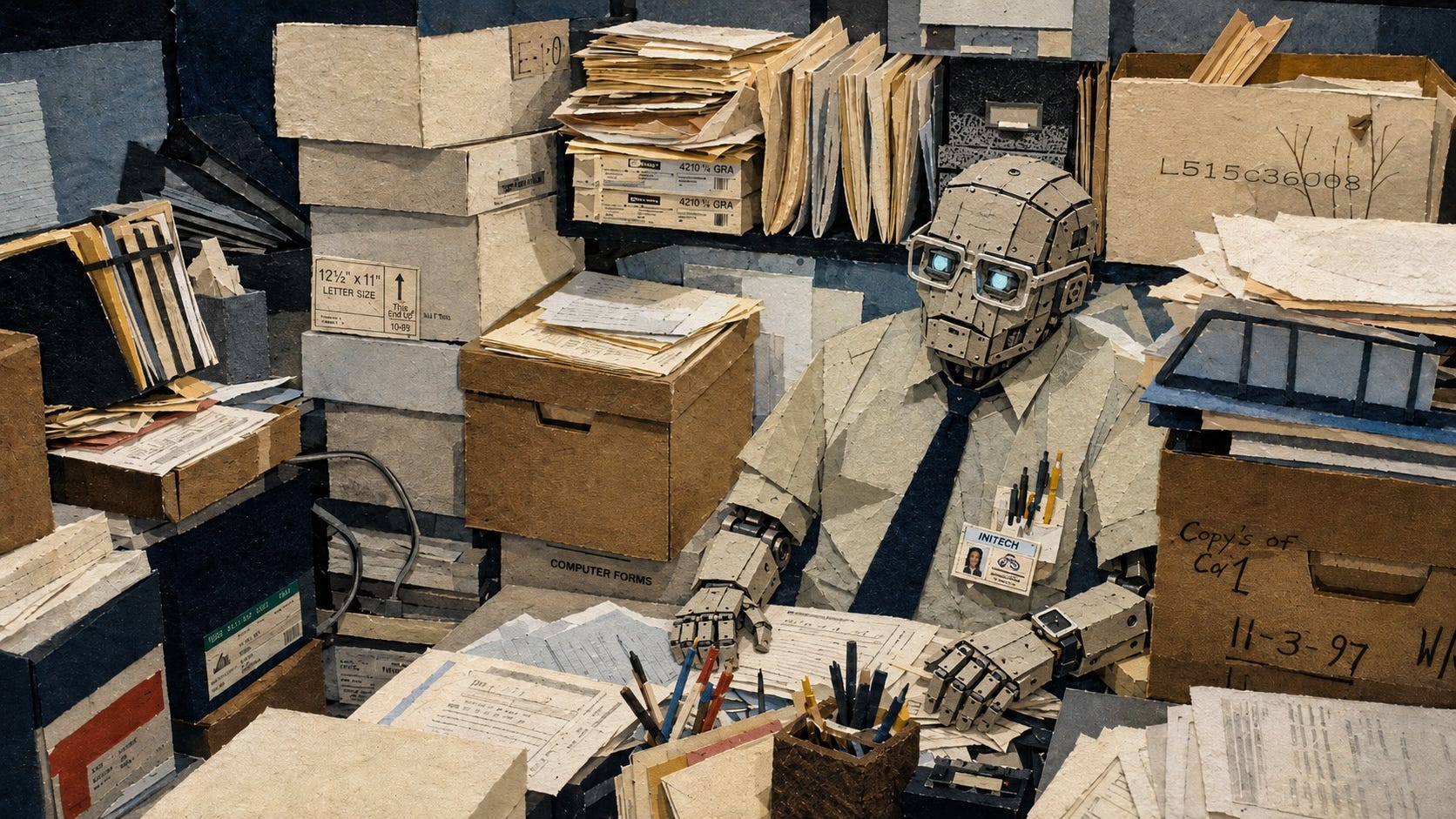
This week’s main thing
This spring, the big AI labs stopped branding their tools “assistants” and started calling them “teammates.” They pushed organizations to think of these tools as employees and now roughly 1-in-4 companies have already given one a box on the org chart.
But it’s the wrong metaphor, and here’s why:
You can’t hold it accountable. You can fire, sue, or demote a person. You can do none of that to a system. It can’t be held responsible no matter how capable it gets.
Calling it a colleague makes people check it less. In one study, 1,261 managers reviewed the same flawed work. Those told it came from an “AI employee” rather than a tool caught 18% fewer of the errors, and felt less responsible for the misses.
It gives people a way to avoid owning hard decisions. Most managers have already used a chatbot to help with layoffs and firings, and one in five let it make the call with no human review. “The AI decided” lets a person make the decision without answering for it.
It can’t do what a teammate does. A teammate tells you when it’s unsure. This states a wrong answer as confidently as a right one, and never flags its own doubt. Researchers who study human-machine teams have made this point for twenty years.
“Teammate” hides how much authority you’re handing over. A peer doesn’t decide who gets hired or fired.
What to say to your CEO: this isn’t about trusting the AI less. It is about calling it what it is. Not a colleague, a tool. A powerful one, used by a named person who answers for it.
This week’s move: put the tool where it belongs, off the org chart
AI isn’t a who. It is a what, and it’s time to get concrete about accountability: name a human who owns whatever it produces.
Sort your systems by one question. Does a person touch every output before it counts, or does the thing act on its own?
Where a person touches it, the owner is whoever acts on the output. Whoever sends the email, merges the code, or extends the offer owns it as if they’d done it themselves. No new role, no new box. You are refusing to let “the AI produced it” be the end of the chain.
Where it acts on its own, the auto-send, the auto-reject, the score that fires with no human in the loop, put one named senior person on all of it, in advance. If no name will go there, then no one owns its decisions, and that is the first thing to fix.
Hand AI drafting and analysis freely: memos, code, first passes, pulling data, laying out options. Two things it should never fully own, however good it gets:
Any decision about a person: who is hired, promoted, paid, managed out, or fired.
Anything you can’t take back or reverse.
Top stories
Calling an AI a colleague makes managers check it less. Boston University and Boston Consulting Group gave 1,261 managers the same flawed work to review. Some were told it came from an AI tool, others from an “AI employee.” Those reviewing the “employee” caught 18% fewer of the errors, felt less responsible for the misses, and escalated questionable work 44% more often (versus tackling it directly), which cancels the time the agent was meant to save. Nearly a quarter of surveyed firms now list AI agents on the org chart. (MIT Technology Review, June 29)
Managers are already routing firing decisions through chatbots. A 2025 survey of 1,342 U.S. managers found six in ten used AI to make decisions about their direct reports: 66% for layoffs, 64% for terminations, 78% for raises, 77% for promotions. More than one in five said they let the AI make the final call with no human input. Two-thirds had received no training on the tools. (ResumeBuilder, 2025)
AI is the top stated reason for layoffs, and nobody has to prove it. AI was the leading cited reason for U.S. job cuts for a fourth straight month, according to Challenger, Gray & Christmas, named in 101,743 layoff announcements in the first half of 2026, with tech taking nearly a third of the cuts. No federal law requires a company to show that AI actually drove a layoff. So “we cut roles because of AI” is, for now, a claim no one can audit. (Challenger, Gray & Christmas, July 2026)
Courts are starting to treat algorithmic hiring as the employer’s decision. In Mobley v. Workday, a federal judge in California ruled on June 22 that state discrimination claims can proceed against Workday over its AI screening tools. The plaintiff was rejected from more than 100 jobs, often within minutes, which suggests no human review; Workday disclosed its software had rejected 1.1 billion applications. California’s rules (effective October 2025) and New York City’s bias-audit law now treat automated hiring and firing as the employer’s responsibility, not the tool’s. (HR Dive, June 2026)
Google’s own AI chief calls the layoff wave “imitative.” Demis Hassabis, who runs Google DeepMind, said much of the current cutting is “imitative behaviour,” companies laying people off and citing AI mainly because their competitors are. From someone building the technology, it is a check on the “the AI made us do it” story. Often the AI is the reason given, not the reason. A human chose the cut and named the machine. (IBTimes UK, June 2026)
Last time around
In 1899, at the Bethlehem Steel Company, Frederick Winslow Taylor ran an experiment in loading pig iron. He picked a laborer he later called “Schmidt,” timed him with a stopwatch, and directed exactly when to lift, walk, and rest. In Taylor’s account, output rose from about 12.5 tons a day to 47.5. He built a movement on results like this, “scientific management.” Its core act was moving a judgment: the decision about how the work should be done shifted from the worker doing it to the system measuring it.
That is the pattern under this week’s story, one era earlier. Taylorism took judgment from the worker and gave it to management. What is new in 2026 is not the transfer but where the judgment ends up. Taylor moved it to human managers, people a worker could question or hold responsible. Route the same decisions through an AI “teammate” and the judgment leaves the reach of anyone who can be asked to answer for it.
The efficiency was real then, and it is real now. So was the cost. (Frederick Winslow Taylor, The Principles of Scientific Management, 1911)
Potpourri
From someone doing it. Two well-known engineers wrote separately in June and reached almost the same point. Charity Majors warned that when you ship code faster than your engineers can read it, in systems where nobody holds the full picture, you are drawing down a “trust account” that took years to build. Kent Beck argued for what he called a “trust factory”: slowing down enough to be sure the work holds and to keep people talking to each other. Both were describing what happens when the tool outruns the humans meant to vouch for it. (Charity Majors, June / Kent Beck, June 2)
Overheard. At a conference, after two HR executives praised treating AI agents as real employees, one went further and said her company would soon have AI employees managing humans. As the researcher Emma Wiles recalled it, “a hush went over the room.” (The New York Times, June)